Apr 08,2026
Dehydrated red pepper is commercially available in three primary particle size categories: fine powder (under 0.5mm), granules (0.5mm–3mm), and flakes (3mm–10mm or larger). Each form serves distinct culinary, industrial, and food manufacturing applications. Understanding these size distributions helps buyers select the most suitable product for their specific processing needs, flavor requirements, and end-use applications.
Overview of Particle Size Categories for Dehydrated Red Pepper
The particle size of dehydrated red pepper is determined during the milling, grinding, or cutting stage of post-dehydration processing. Manufacturers typically offer standardized size ranges, though custom specifications can often be arranged for large-volume commercial buyers. The three main forms are:
- Powder: Finely ground, typically passing through an 80–100 mesh screen (approximately 0.15mm–0.18mm)
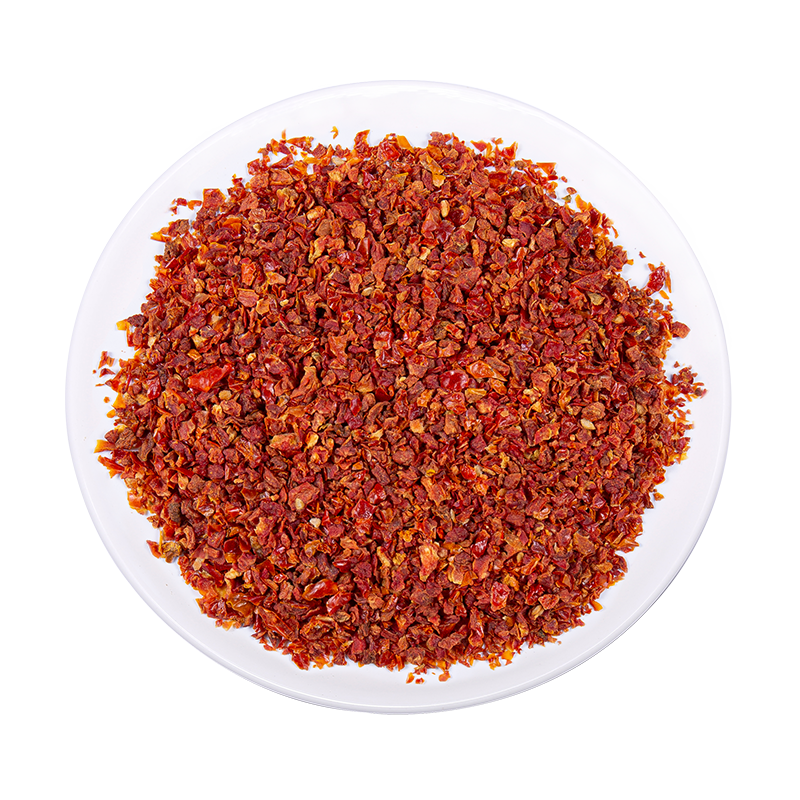
- Granules: Medium-coarseness particles ranging from 0.5mm to 3mm, often described as coarse powder or cracked pepper
- Flakes: Larger, visually intact pieces from 3mm up to 10mm or more, often retaining visible seed and skin fragments
Some suppliers further subdivide these categories into more specific mesh sizes or cut dimensions to meet the technical specifications of industrial food production lines.
Detailed Particle Size Specifications by Form
The table below summarizes the standard particle size specifications commonly offered by commercial dehydrated red pepper suppliers, along with typical mesh equivalents and recommended applications:
| Form | Particle Size Range | Mesh Equivalent | Primary Applications |
|---|---|---|---|
| Fine Powder | 0.15mm – 0.18mm | 80 – 100 mesh | Seasoning blends, sauces, soups, spice rubs |
| Coarse Powder | 0.18mm – 0.5mm | 40 – 80 mesh | Dry marinades, flavored snack coatings |
| Fine Granules | 0.5mm – 1.5mm | 10 – 40 mesh | Processed meats, ready meals, instant noodles |
| Coarse Granules | 1.5mm – 3mm | 6 – 10 mesh | Pizzas, bread toppings, spice blends with texture |
| Small Flakes | 3mm – 6mm | 3 – 6 mesh | Pasta sauces, stews, rehydrated vegetable mixes |
| Large Flakes | 6mm – 10mm+ | < 3 mesh | Retail seasoning shakers, visual garnish, salads |
How Particle Size Affects Flavor Release and Color Performance
Particle size directly influences both the rate of flavor release and the visual color impact of dehydrated red pepper in a finished product. Finer powders dissolve rapidly and deliver immediate, uniform flavor intensity, making them ideal for liquid-based products like sauces, soups, and marinades. The increased surface area also enhances the extraction of capsaicin and red pigments (capsanthin and capsorubin), which are responsible for both heat and the characteristic ASTA color value.
In contrast, coarser flakes release flavor gradually during cooking or rehydration. This slow-release profile is beneficial in slow-cooked dishes, stews, and food service applications where the pepper needs to maintain its structural integrity while softening over time. Large flakes with a particle size above 6mm retain their shape during rehydration and provide visible color contrast, which is highly valued in premium retail spice blends and fresh-looking prepared meals.
From a color standpoint, fine dehydrated red pepper powder typically achieves an ASTA color value of 100–180 or higher, while whole flakes tend to show lower measured ASTA values simply due to less exposed surface area per unit volume, not because of reduced pigment content.
Rehydration Performance by Particle Size
Rehydration time is one of the most practically important differences between particle size categories. Buyers who use dehydrated red pepper in ready-to-eat meals, instant soups, or freeze-dried ration packs need to ensure the rehydration rate matches their product's preparation time.
- Fine powder (80–100 mesh): Dissolves almost instantly in hot liquid; no pre-soaking required
- Granules (0.5mm–3mm): Full rehydration typically achieved within 5–15 minutes in hot water (80–100°C)
- Small flakes (3mm–6mm): Require approximately 15–25 minutes of simmering for complete rehydration
- Large flakes (6mm–10mm+): Best rehydrated with a cold soak of 30–60 minutes, or 20–30 minutes of active cooking at medium heat
For cold-fill or no-cook applications, only fine powder or pre-rehydrated forms are suitable. Buyers should confirm the rehydration ratio with their supplier — a typical ratio for dehydrated red pepper flakes is 1:5 to 1:7 (dry to rehydrated weight), depending on the original moisture content (usually 6–9% for commercial-grade product).
Industrial vs. Retail Particle Size Preferences
The appropriate particle size for dehydrated red pepper varies significantly depending on whether the buyer is an industrial food processor or a retail consumer product manufacturer.
Industrial Food Processing
Large-scale processors typically prefer fine to medium granules (0.5mm–2mm) or fine powder for use in automated dosing systems, continuous mixing lines, and standardized seasoning blends. Consistent particle size distribution is critical in this context — variations can cause uneven flavor dosing, equipment clogging, or inconsistent final product appearance. Industrial buyers typically specify a maximum allowable percentage of off-size particles, such as no more than 5% of particles outside the target mesh range.
Retail and Food Service
Retail spice brands and restaurant supply companies often favor medium to large flakes (3mm–10mm) because they offer strong visual appeal on the shelf and visible texture in the finished dish. Retail shaker bottles typically contain flakes in the 3mm–6mm range, which flow freely without caking while maintaining a recognizable, appetizing appearance.
Custom Particle Size Requests and Quality Verification
Many established suppliers of dehydrated red pepper are able to accommodate custom particle size specifications upon request, particularly for orders above a minimum quantity threshold — commonly around 500kg to 1 metric ton for custom milling runs. When placing a custom order, buyers should request the following documentation:
- Particle Size Distribution (PSD) report: A laboratory analysis confirming the percentage of particles within each size fraction, typically generated by sieve analysis
- Certificate of Analysis (COA): Covering moisture content, ASTA color value, microbial limits, and mesh size compliance
- Pre-shipment sample: A physical sample from the production batch for in-house verification before accepting bulk delivery
- Batch consistency records: Documentation showing sieve screen sizes and post-grinding quality checks used during production
Sieve analysis remains the industry-standard method for verifying particle size distribution in dehydrated vegetables including red pepper. Results are expressed as the percentage retained or passing through a series of standard mesh screens (e.g., ASTM or ISO mesh standards). A well-controlled dehydrated red pepper product should have at least 90% of particles within the specified size range, with minimal fines or oversized pieces.
Key Considerations When Selecting Particle Size
When choosing the right particle size of dehydrated red pepper for your application, consider the following practical factors:
- End product texture: Does the final product benefit from visible pepper pieces, or does an even, smooth color and flavor distribution matter more?
- Processing method: Will the pepper be added to a liquid medium, dry-blended, or used as a surface coating?
- Cooking or preparation time: Short cooking windows favor fine powders or granules; longer cooking or soaking allows flakes to rehydrate fully
- Packaging and flowability: Fine powders may require anti-caking agents; flakes tend to be more stable in bulk storage
- Regulatory and labeling requirements: Some markets require declaration of additives used in processing, which may vary by particle form
Selecting the correct particle size is not merely a technical specification — it is a decision that directly impacts flavor consistency, production efficiency, consumer experience, and overall product quality. Working with a supplier who offers certified PSD data and flexible custom sizing is essential for any professional food manufacturer or large-scale buyer sourcing dehydrated red pepper.